

Every PCB assembly house advertises 24-hour turnaround somewhere on its homepage, and almost none of that number holds up when you send a real order. The 24 hours usually describes bare fabrication on a simple two-layer board with no assembly, not a fully populated, tested board with BGAs and a mixed BOM sitting on your desk the next morning. Quick turn PCB assembly is a genuinely useful tool—but only once you understand what drives the premium and which projects are worth paying for it.
What Is Quick Turn PCB Assembly?
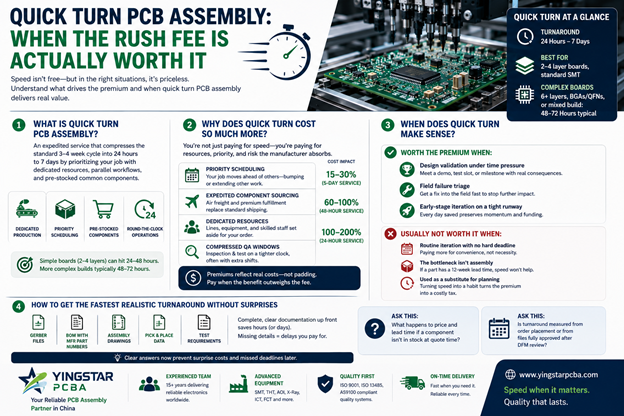
Quick turn PCB assembly is an expedited manufacturing service that compresses the standard 3-4 week production cycle into 24 hours to 7 days by dedicating production resources, running parallel workflows instead of batching your order with others, and prioritizing your job ahead of standard-queue work. Simple 2-4 layer boards with standard SMT components have the best shot at the tightest windows on a turnkey basis. Items that are 6+ layers, have BGAs or QFNs, or are a hybrid through-hole/surface mount are normally 48 to 72 hours under a quick-turn service, but are being advertised as 24 hours.
The speed comes from real operational changes, not magic: dedicated lines, pre-stocked common components, and often round-the-clock shifts rather than a queue that runs on the manufacturer’s normal schedule.
Why Does Quick Turn Cost So Much More Than Standard Assembly?
Quick turn PCB assembly typically costs 15-30% more for 5-day service, 60-100% more for 48-hour service, and 100-200% more for true 24-hour service, compared to standard 15-25 day lead times. That’s not padding — it reflects specific costs the manufacturer is actually absorbing on your behalf.
- Priority scheduling. Your board jumps ahead of other customers’ standard-queue orders, which means someone else’s job gets bumped or the line runs overtime to fit both.
- Expedited component sourcing. Instead of waiting on standard shipping from a distributor, rush orders often pay for air freight or premium fulfillment on parts that would otherwise arrive on a normal schedule.
- Dedicated resources. A line held open and staffed for rush work isn’t running someone else’s standard order in that slot, and that idle capacity gets priced into what you pay.
- Compressed QA windows. Inspection and test still have to happen — they just happen on a tighter clock, sometimes with additional shift coverage to keep pace.
None of this means quick turn is a bad deal. It means the premium buys something specific, and if your project doesn’t need it, you’re paying for capacity you don’t use.
When Does Quick Turn PCB Assembly Actually Make Sense?
Quick turn PCB assembly is worth the premium when a hard external deadline—a trade show, an investor demo, a critical field bug—makes missing that date more expensive than the rush fee. It stops making sense the moment “fast” becomes a default habit rather than a response to a real constraint.
A few scenarios where the math clearly favors paying for speed:
- Design validation under time pressure. You need functional silicon in hand before a specific gate — a demo, a certification test slot, an investor milestone — and a slipped date has real consequences beyond schedule annoyance.
- Field failure triage. A production unit is failing in the field, and you need a revised board fast to confirm a fix before it ships to more customers.
- Early-stage iteration on a tight runway. A startup burning through a limited number of design spins before a funding or launch deadline can lose more value from a delayed iteration than the rush premium costs.
And a few where it usually doesn’t:
- Routine design iteration with no external deadline. If nothing bad happens when the board arrives a week later, you’re paying 60-100% more for a convenience, not a necessity.
- Boards where the bottleneck isn’t assembly speed. If your actual constraint is a 12-week lead time on an allocated component, paying for 48-hour assembly turnaround doesn’t move your real delivery date at all — the part is still the gate.
- Repeated use as a substitute for planning. If quick turn becomes the default because design reviews are repeatedly pushed late into the system, the premium becomes a tax on scheduling issues rather than manufacturing issues.
How to Get the Fastest Realistic Turnaround Without Surprises
Complete, unambiguous documentation shortens quick-turn lead times more than almost anything else you control. Submit Gerber files, a BOM built with actual manufacturer part numbers rather than descriptions, assembly drawings, and clear test requirements up front — any back-and-forth to clarify a missing detail eats directly into the window you’re paying a premium to compress.
Before committing to a quoted turnaround, ask two questions directly: what happens to the price and the date if a component on your BOM isn’t in stock at quote time, and is the advertised turnaround measured from order placement or from design files being fully approved through DFM review? Manufacturers vary on both, and the gap between “advertised” and “actual” is where most quick turn disappointment happens.
Conclusion
Quick turn PCB assembly earns its premium when a real deadline drives the order, and the board’s complexity fits the window you’re paying for—not as a standing habit for every prototype spin. Verify your real constraint before buying speed: if it is component lead time rather than assembly turnaround, a faster assembly slot would be a worthless purchase. Align the service to the constraint, and quick turn can be a valuable option instead of simply another upcharge for common delays.
