


Smart eyewear keeps promising to move more phone tasks into your line of sight. Most of it falls short. The RayNeo X3 Pro is an AI+AR pair that runs its own apps, a built-in assistant, and a camera, not a tethered display or a camera-only frame.
These are AI glasses built around three claims: a Google Gemini assistant, real-time translation, and a 12MP camera. This piece checks those claims against RayNeo’s specs and early hands-on reviews.
With a $1,299 list price, it sits in the premium tier for AI+AR smart glasses. That price folds in hardware many rivals split across two or three products.
Specs at a Glance
Start with the numbers. The RayNeo X3 Pro runs on Qualcomm’s 4nm Snapdragon AR1 Gen 1, the same chip class found in many AI smart glasses. It weighs 76 grams, pairs Wi-Fi 6 with Bluetooth 5.3, and ships with 32GB of storage.
| Spec | RayNeo X3 Pro |
|---|---|
| Display | Binocular full-color MicroLED, 43-inch image |
| Peak brightness | Up to 6,000 nits |
| Camera | 12MP Sony IMX681, 4K/3K video |
| Processor | Snapdragon AR1 Gen 1 (4nm) |
| Assistant | Google Gemini 2.5 |
| Translation | 14 languages |
| Battery | Up to 5 hrs rec / 3 hrs music / 36 min video |
| Weight | 76 g |
| Price | $1,299 |
Gemini, Built In
Most AI glasses lean on a paired phone for the heavy lifting. The X3 Pro is built to stand more on its own. AI Glasses like this one fold a Gemini-powered assistant into the display, backed by the Snapdragon AR1 platform on the glasses themselves.
An Assistant That Stays On
Gemini activates on command. Ask for a fact, a quick summary, or a calculation, and the reply comes back through the speakers and onto the lenses. RayNeo lists Gemini 2.5 as the model, with always-on assistance as the stated goal.
What Gemini Handles
In normal use, the assistant covers the basics. It sets reminders, answers questions, and places navigation prompts in your line of sight. It also ties into the RayNeo X3 Pro’s own tools for notes and schedules. Requests that need more power route through the cloud.
Why These AI Glasses Feel Standalone
The payoff is independence. The glasses run RayNeo AIOS, support an AR app ecosystem, and connect over Wi-Fi, so some tasks feel less phone-dependent than tethered display glasses. The Snapdragon AR1 platform drives the camera, display, and connectivity. Heavier AI requests, RayNeo notes, may still rely on the cloud.
The Catch
Battery is the soft spot. RayNeo lists up to five hours of recording, three of music, or 36 minutes of video. A 38-minute fast charge over USB-C helps. Even so, heavy mixed use drains it faster, and long-term reviewers have flagged runtime as a real limit.
Translation You Can Read
Live translation is where the RayNeo X3 Pro makes its clearest case. Rather than pipe a translated voice into your ear, it prints subtitles on the lenses. You hold eye contact and read the conversation as it happens.
Subtitles on the Lens
The system supports 14 languages, with the engine powered by Microsoft. Captions float in view while the other person speaks. For a one-on-one chat across a language gap, reading the text beats hearing a synthetic voice, and you stay looking up instead of down at a screen.
Two Ways to Listen
Two modes split the work. Face-to-face tunes the microphones for a close, direct conversation. Listening mode reaches for a distant voice, like a tour guide or a lecturer at the front of a wide room. A tap on the temple switches between them.
Where Translation Breaks Down
It is not perfect. Connection quality can affect the more complex translation tasks. RayNeo cites about 2.1 seconds for translation. Strong accents, slang, and technical jargon can still confuse it, which lines up with how most translation systems behave today.
The Camera and the Display
The other half of the pitch is what the glasses see and show. The RayNeo X3 Pro carries two cameras and a pair of color microdisplays. For a 76-gram frame, that is a dense stack of optics for AI glasses this light to balance.
The 12MP Sony Sensor
The main camera pairs a Sony IMX681 sensor with 12MP stills. Shots come from a first-person angle, framed by what you actually see. RayNeo lists 4K and 3K video, while some early reviews reported 1440p capture, with higher resolution expected through software updates.
A Second Camera for Tracking
A second, monochrome camera sits beside it. Its job is not photography. It manages positioning and spatial tracking, and it enables dual recording. This is the sensor that lets the glasses read where you stand and hold the floating screen steady as you turn your head.
Full-Color MicroLED
The display stands out. Each eye gets a full-color MicroLED panel driven by RayNeo’s Firefly optical engine. Colors stay solid indoors and out. A binocular image across both eyes feels more balanced than a single-eye notification pane.
Reading the Floating Screen
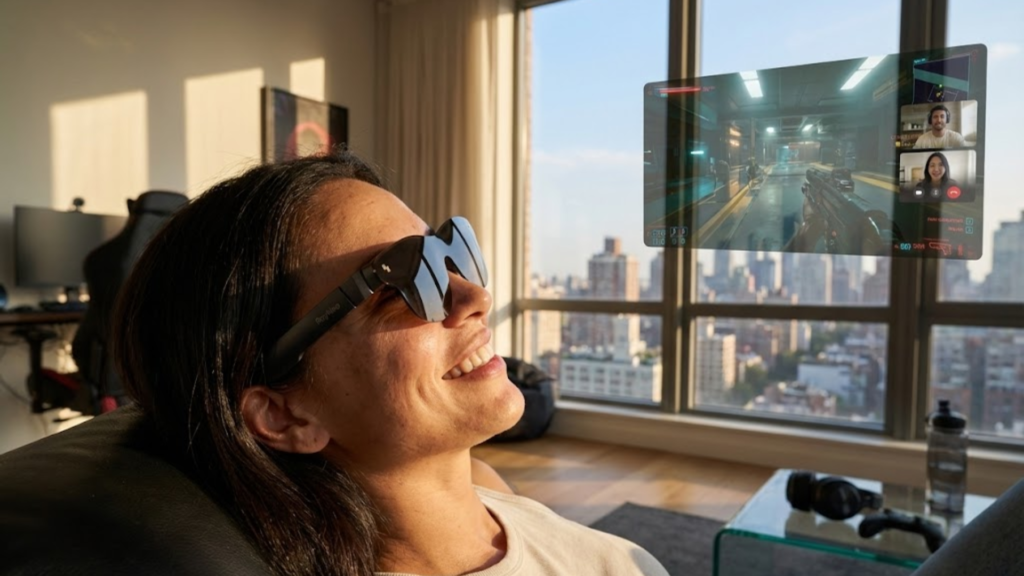
Brightness leads the spec sheet. RayNeo cites up to 6,000 nits at peak, which keeps the floating screen readable in daylight, a weak spot for many AI glasses. The panel casts a 43-inch-equivalent image that hangs in front of you without fully blocking the room.
How the RayNeo X3 Pro Compares
Few AI glasses try to do everything at once. Most pick one lane. This is less a head-to-head than a comparison of routes, so the table lines up the RayNeo X3 Pro against three: Meta’s display AI glasses, Even Realities’ discreet HUD, and XREAL’s tethered display.
| Feature | RayNeo X3 Pro | Meta Ray-Ban Display | Even Realities G2 | XREAL One Pro |
|---|---|---|---|---|
| Display | Binocular color MicroLED | Single-eye color 600×600 | Green MicroLED HUD | Tethered color Micro-OLED |
| Built-in camera | 12MP | 12MP | None | None; optional XREAL Eye |
| Assistant | Gemini 2.5 | Meta AI | Even AI | None |
| Translation | 14 languages | Yes | Yes | No |
| Standalone use | More standalone | Phone-linked | Phone-linked | Tethered display |
| Official price shown | $1,299 | $799 | $599 | $649 |
Against Display Glasses
Meta’s display model and the Even Realities G2 both surface information cleanly. Neither pairs a full-color binocular screen with an on-board camera in one frame. They also cost less, and for many buyers that trade-off reads as the smarter pick among today’s AI glasses.
Against Camera Glasses
Camera-first glasses shoot solid clips and weigh less on your face. What they leave out is a rich display in front of both eyes. The RayNeo X3 Pro asks for more money and a little more weight, then returns a full visual layer in exchange.
The Verdict
On paper and in early reviews, the RayNeo X3 Pro is the most complete pair in this class. It folds a Gemini-powered assistant, readable translation, and a 12MP camera behind one full-color binocular display. Few devices attempt this much at once.
The trade-offs are real. Not every feature feels equally mature yet, especially battery life, app depth, and cloud-dependent AI tasks. Even so, little else packs this many working features into a 76-gram frame. For buyers who want the full set today, it delivers.
